inspired by Paper (RALF) published in VLDB 2023
Overview
RALF proposes an accuracy-aware scheduling policy for feature stores: when featurization is expensive and updates can’t keep up, prioritize updating the keys whose staleness hurts downstream prediction accuracy the most.
But the more interesting contribution — and the focus of this note — is the perspective shift the paper implicitly introduces. RALF treats the feature store as a big table where maintenance happens at the row level (per-entity), in contrast to the column-level (per-feature batch) maintenance that dominates today’s systems like Feast, Hopsworks, Tecton, and Databricks Feature Store.
Two Views of Feature Store Maintenance
A feature store is fundamentally a large table: rows = entities, columns = features.
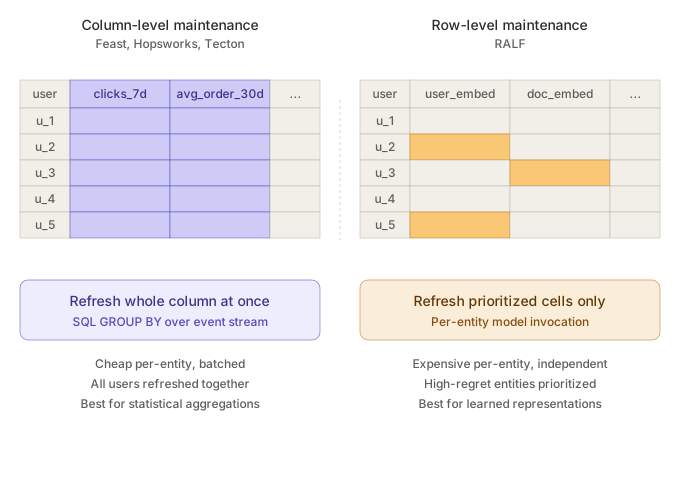
Column-Level Maintenance (Mainstream Today)
Most production feature stores treat maintenance as a per-column batch job:
user_click_sum_7d→ SQL aggregationGROUP BY user_idover the click streammerchant_avg_order_30d→ rolling window over orders- Each refresh updates the entire column for all entities at once
This fits relational aggregations beautifully. The unit of work is a whole feature pipeline; scheduling means deciding when to rerun each pipeline. Systems like FeathrPO optimize this dimension — point-in-time joins, layout selection, materialized view reuse.
Row-Level Maintenance (RALF’s Contribution)
RALF flips the axis. The unit of work becomes one entity’s value for one feature, computed independently:
user_embedding[user_42]→ run the encoder on user_42’s recent activityvm_stl_decomp[vm_17]→ fit STL on vm_17’s CPU history- Each refresh updates one cell, and cells can be prioritized independently
This fits model-derived per-entity features — embeddings, time-series fits, learned representations. The featurization is expensive (one model call per entity) and naturally parallel across keys.
RALF: Accuracy-Aware Row-Level Scheduling
Motivation
If you accept the row-level view, an immediate question follows: with millions of rows and a fixed compute budget, which cells do you refresh first?
Existing systems answer this with Round-Robin or FIFO — process updates in arrival order, treat all keys symmetrically. This wastes budget badly. In production:
- Some keys are queried far more than others (Zipfian access patterns)
- Some keys’ features drift fast (active users, bursty workloads); others barely change (dormant entities)
- The value of updating a cell varies by orders of magnitude across rows
RALF’s insight: let the downstream model tell you which cells matter. The model’s prediction errors carry exactly the signal needed — if a feature is stale enough to hurt accuracy, the predictions made with it will be wrong, and that wrongness can be fed back to the scheduler.
Workload Example: Anomaly Detection on Cloud VMs
Modeled on Splunk’s production system: a cloud platform monitors 275,077 VMs, each emitting a CPU reading every 5 minutes. For each VM, the feature is an STL decomposition (trend + daily seasonality) fitted over the last 72 hours of readings, used downstream to predict expected CPU values and flag anomalies. Each VM is one row in the feature table; its STL fit is the feature value.
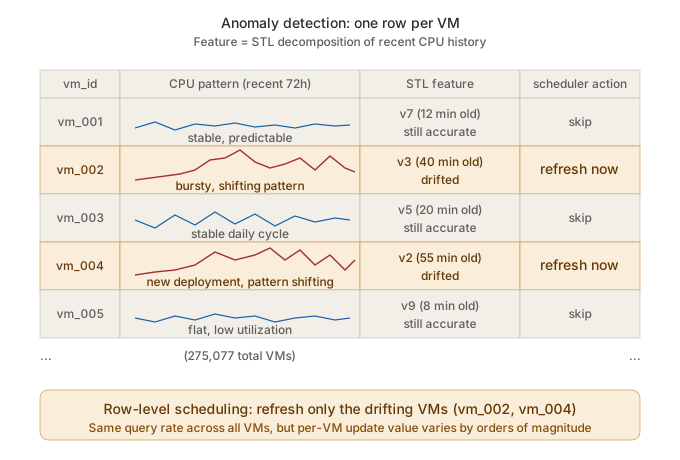
Why it’s row-level: each fit depends only on that VM’s own history — vm_002’s STL is independent of any other VM. Cells can be updated in any order.
Why scheduling matters: each fit costs ~0.3 seconds. Refreshing all 275K rows continuously would need ~22 hours of CPU per round, so only a subset can be updated each interval.
Why row priorities differ: every VM is queried equally, but staleness sensitivity is wildly non-uniform. Stable VMs (vm_001, vm_003, vm_005) produce accurate predictions even with old features; drifting VMs (vm_002, vm_004) need fresh features to avoid large errors. Column-style “refresh everyone” wastes budget on the stable majority; RALF routes it to the drifting rows.
This pattern recurs whenever features are learned representations of per-entity history — user embeddings, document encodings, per-merchant fraud profiles.
The Trend: Row-Level Will Matter More
Features are shifting from statistical (counts, averages, ratios) to semantic (vector embeddings produced by neural models). Statistical features are cheap and batch well — column-level maintenance handles them fine. Semantic features are one expensive model call per entity.
Concrete example: “For each user, summarize their last 30 days of support interactions with GPT-4 and store the embedding.” Each update costs a real API call (~$0.01–$0.10) and hits hard rate limits. Refreshing 10M users hourly is economically infeasible — and wasteful, since most users haven’t interacted.
This is exactly RALF’s target: expensive, per-entity, independent, with non-uniform update value. As LLM-derived features become standard, row-level prioritization moves from edge case to first-class concern.
Vision: A Hybrid Feature Store
Can a single feature store natively support both column-level and row-level maintenance? This is the feature-store analog of the OLTP vs OLAP split — same logical data, fundamentally different access patterns and optimization techniques. HTAP systems work hard to bridge them under one roof; feature stores face the same challenge.
| Column-level | Row-level | |
|---|---|---|
| Unit of work | Whole feature column | Single (entity, feature) cell |
| Cost driver | Data volume scanned | Per-entity model invocation |
| Optimization | PIT joins, materialized views (FeathrPO) | Priority scheduling, regret (RALF) |
| Bottleneck | I/O, scan cost | Compute, API rate limits |
Today’s feature stores commit to one side — Feast and Hopsworks are column-oriented, RALF is pure row-level. But real ML pipelines mix both: a fraud predictor uses card_txn_count_24h (column) and cardholder_embedding (row) in the same prediction.
A hybrid system needs to resolve:
- Unified API for defining both feature kinds with one abstraction
- Global budget allocation between SQL aggregations and embedding refreshes
- Storage layout — shared tier, or separate (vector DBs vs aggregation stores)?
- Cross-mode consistency for point-in-time joins spanning both feature types
Leave it to the future work.