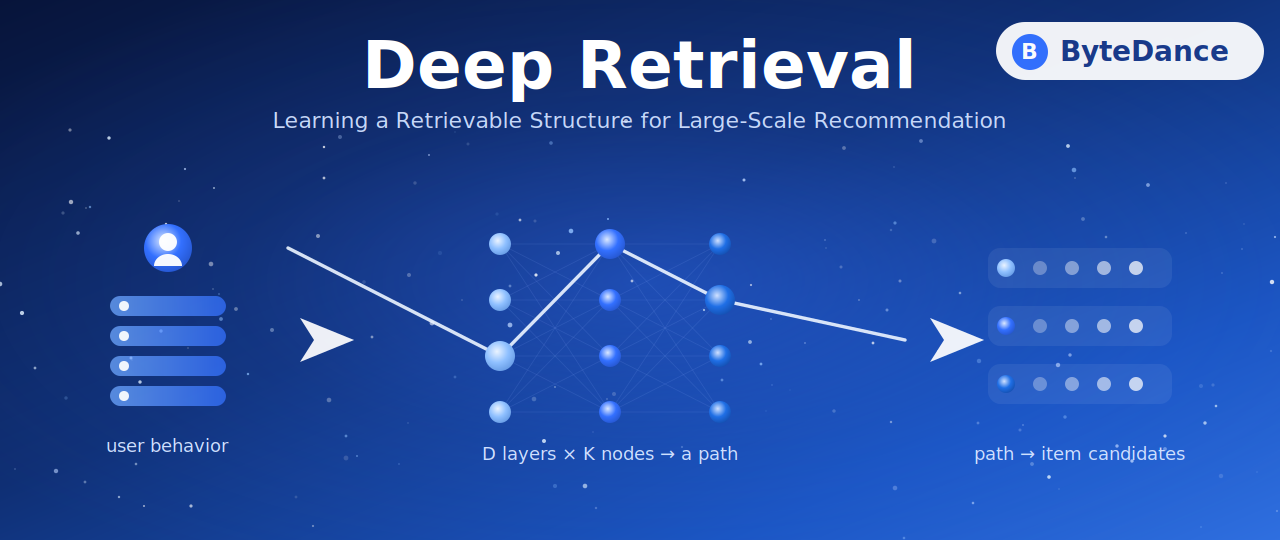
Learning a retrievable structure end-to-end for large-scale recommendation in Bytedance Paper: arXiv:2007.07203
1. Motivation
Classic recall uses two-tower + ANN: user and item are each embedded into a vector, similarity is an inner product, and an ANN index approximates top-K search over hundreds of millions of items.
Two problems with this:
- Two-stage mismatch. The model learns inner products; the ANN index is built afterwards to approximate that model. The index is not optimized directly against user–item interaction data.
- Inner-product ceiling. Squeezing every interaction into a single dot product limits expressiveness.
DR takes a different route: learn the retrievable structure itself, end-to-end from click data. Each item is encoded onto a discrete path, and retrieval walks that structure instead of scanning vectors.
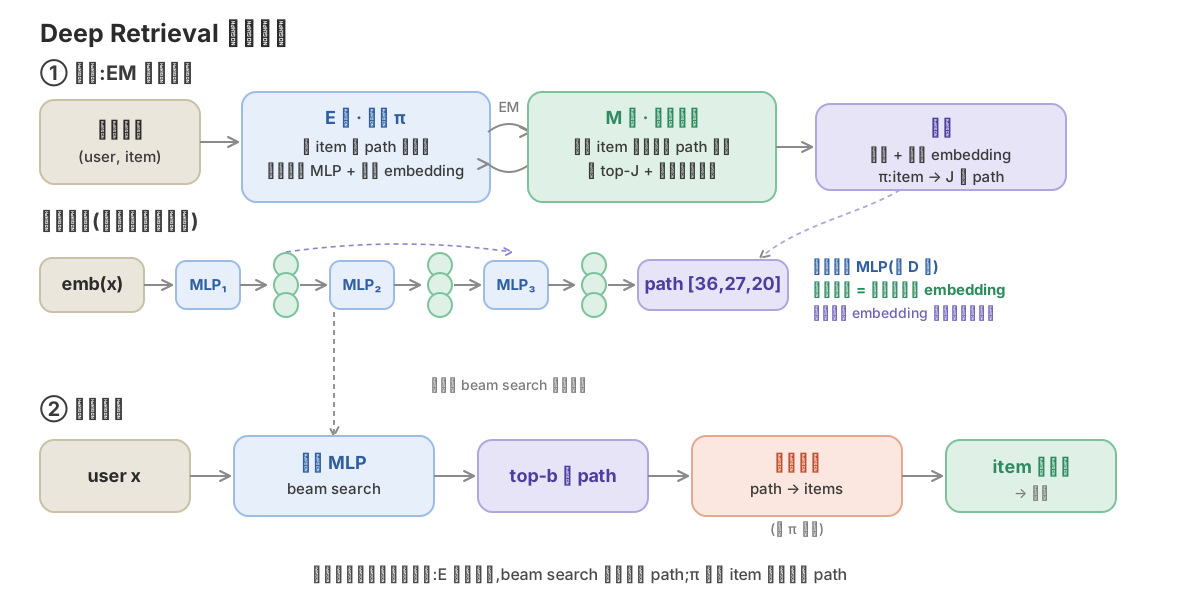
Overview. Using the paper’s example (K=100, D=3): the structure is D columns of K nodes, giving K^D ≈ 1M possible paths. A user walks one MLP-softmax per layer to pick a path, and each path is a cluster holding many items.
2. Algorithm Design
a. The structure: paths
A path is a sequence of node choices across D columns, each column having K nodes (e.g. K=100, D=3). There are K^D possible paths, each acting as an item cluster. Many items hang on one path — DR is built for retrieval, not fine-grained ranking, so items sharing a path need not be distinguished.
Key efficiency: parameters are only Θ(K·D²), yet they express K^D clusters.
b. Assigning a user a path (per-layer prediction)
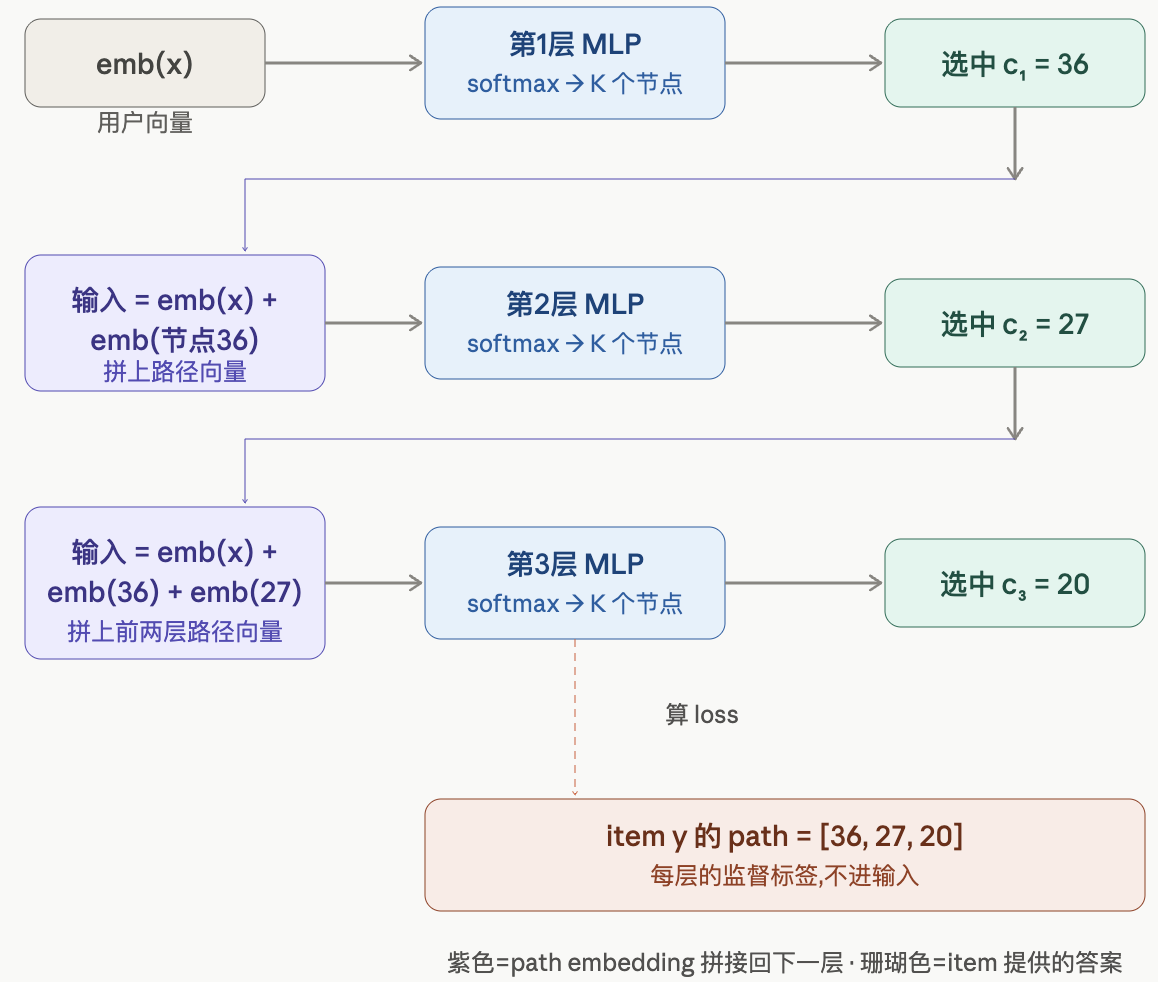
Given a user x, DR predicts the path layer by layer. Each layer has its own MLP whose softmax outputs a distribution over the K nodes. Crucially, each layer’s input is the user vector plus the path embeddings of nodes already chosen — this makes the layers interdependent.
The figure below shows one concrete path to assign a user a path.
- Input:
emb(x)is the user-side input to every layer, in this paper is a GRU over the user’s behaviro sequnece. The GRU encoding is trained jointly with DR network. - MLP: one per layer, softmax over
Knodes. - Label: the item’s path supplies the target of each layer’s softmax. (item never enters the network as input)
Path probability for a user is the product of per-layer softmax probabilities: \(p(c|x) = \prod p(c_d | x, c_{<d})\) At serving time there is no label: the user walks the network and beam search keeps the top-b paths per layer, yielding the most likely paths for that user.
c. Assigning an item a path (the mapping π, learned via EM)
The mapping π: item → path(s) is discrete and non-differentiable, so it cannot be learned by gradient descent. DR uses EM-style alternation:
- E-step (fix π, train the network). Use each item’s current path as the label; users walk the network; standard softmax loss + backprop updates the MLPs and the path embeddings.
-
M-step (fix the network, re-assign π). No gradients — just score and pick:
For item
\[\text{score}(i, c) = \sum_{x \in X_i} p(c \mid x) \;-\; \underbrace{\text{penalty}\big(\#\{\text{items on } c\}\big)}_{\text{load balancing}}, \qquad X_i = \{\,x : x \text{ clicked } i\,\}\]i, take the set of users who clicked it. Each such user walks the network and producesp(c | x)for a candidate pathc. Score the path by summing over those users, then subtract a load-balancing penalty (paths already holding many items are penalized, so popular items don’t all collapse onto a few paths):Sort by score, keep the top-J paths as item
i’s assignment.
Note: the item never runs a forward pass. It only provides a label (E-step) and a set of fans (M-step). Users do the walking; the item is positioned by the users who like it.
Multi-path (J, default 3): an item may occupy several paths to cover multiple semantic facets (e.g. an action-romance film sits in both an action cluster and a romance cluster).
Parameters to keep separate: D = path length, K = nodes per layer, J = paths per item.
d. Serving (path → item)
The learned π is stored as an inverted index (path → item set). At recall time: user → beam search → top-b paths → collect all items on those paths → hand the candidate set to the ranking model. Retrieval cost is largely decoupled from the total item count. And user path is determined by beam search to recall possible items.
e. Online Learning / Training
E-step run online, M-step runs periodically, to keep freshness of structure:
New clicks keep updating the network by SGD. Reassigned π sums over all of an item’s users, so we only refresh it on a schedule.
New users are free:
A user get it’s emb(x) based on historical behavior sequence. A unseen user just gets encoded and walked through the way.
New items need one incremental M-step:
Score the new item against existing paths, keep its top-J. Cold start is the only catch.
3. Advantages
- End-to-end retrievable structure — the index is the model; no separate “learn model, then build ANN” stage with mismatched objectives.
- Low complexity at scale —
Θ(K·D²)parameters expressK^Dclusters; beam search + inverted index scale naturally to hundreds of millions of items. - Multi-facet coverage —
Jpaths per item capture multiple semantic meanings that a single vector would average away. - More interpretable — discrete, hierarchical paths are easier to inspect and debug than an opaque dense vector space. Analyst can manually assign topic for those paths based on the semantics.