
Cheetsheet for the four cases of sharded matmul.
from How To Scale Your Model (Part 3: Sharded Matmuls).
The matmul under analysis is always:
A[I, J] · B[J, K] → C[I, K]
where J is the contracting (summed-over) dimension, and I, K are non-contracting.
Notation
| Symbol | Meaning |
|---|---|
X, Y, Z |
Named hardware axes of the device mesh |
A[I, J] |
Fully replicated — every device holds the whole array |
A[I_X, J] |
The I dimension is sharded across mesh axis X; J is replicated |
A[I_XY, J] |
I sharded across both X and Y (flattened into one big split) |
Rule: a single mesh axis can shard at most one array dimension. A[I_X, J_X] is forbidden — once an axis is “spent” on one dimension, it can’t shard another.
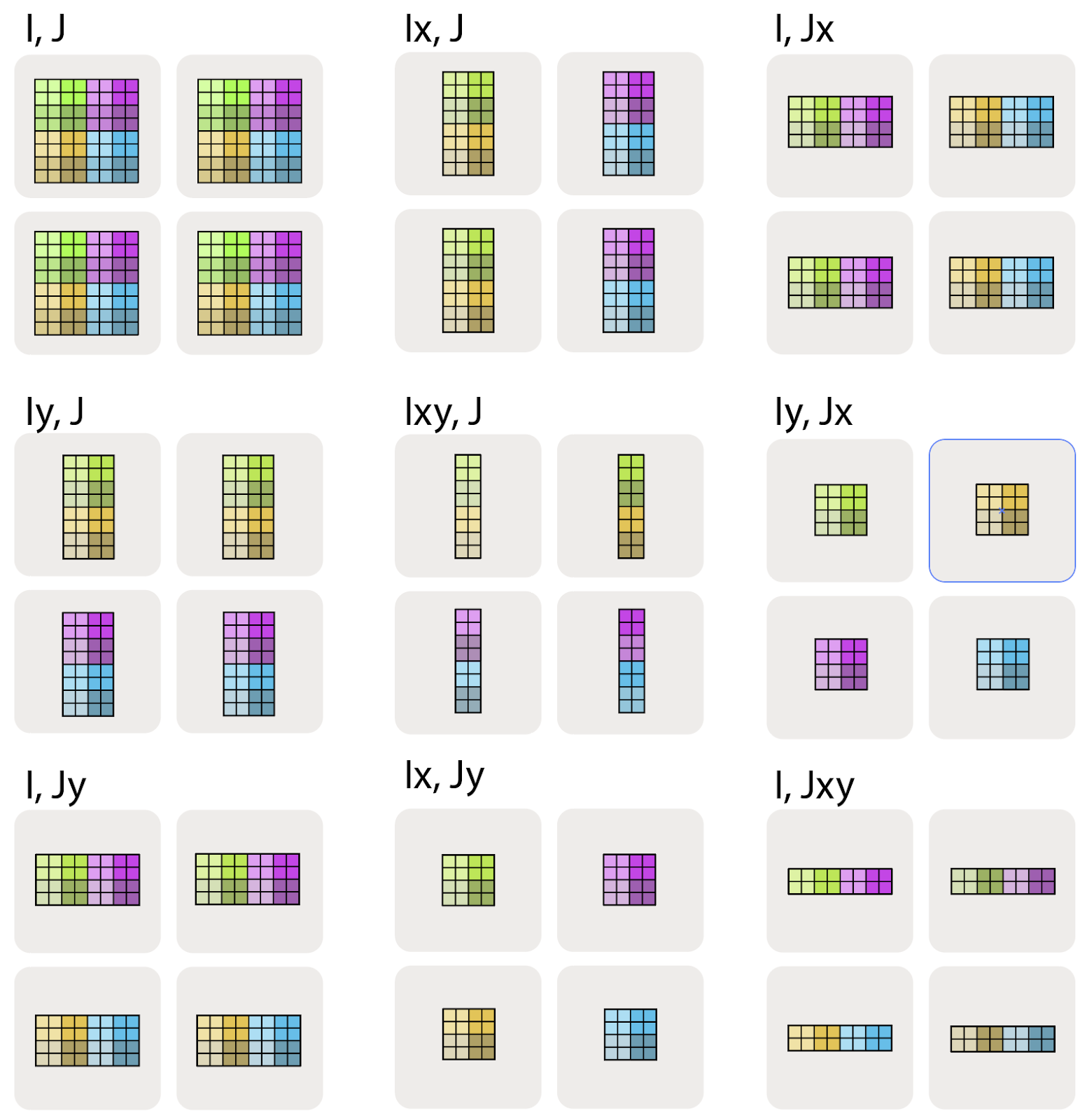
Visualizing shardings
The same 2D array [I, J] laid out across 4 devices (a 2×2 mesh with axes X, Y), under nine different shardings. Each panel shows the four device-local pieces; greyed boxes mean that device holds nothing for that shard. Cell labels are the global (row, col) indices.
Cost symbols (throughput-bound regime):
- V = bytes of the full / global array being moved (e.g.
2·I·Jforfloat16 A[I,J]), not the per-shard size. The shard count cancels out of the cost. - W = bidirectional ICI bandwidth.
- N_axes = the number of mesh axes gathered/reduced in parallel — not the number of chips per axis.
Communication primitives
| Operation | What it does | Cost |
|---|---|---|
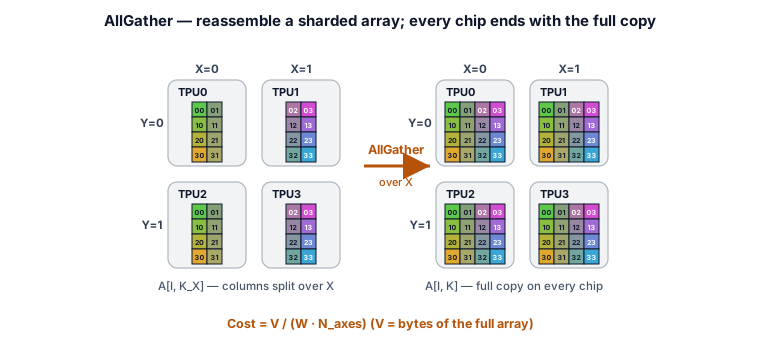
| AllGather | Reassembles a sharded array — every device ends up with the full copy | V / (W · N_axes) |
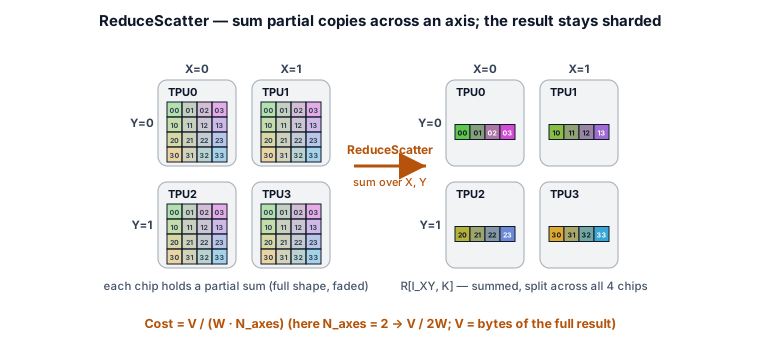
| ReduceScatter | Sums partial results across an axis, leaving the output sharded | V / (W · N_axes) |
| AllReduce | Sums partial results across an axis; every device gets the full sum (= ReduceScatter + AllGather) | 2V / W |
| AllToAll | Reshards: gathers one axis and splits a different one along the same mesh axis | V / (4W) (¼ of AllGather, bidir. ring) |
Case 1 — neither input sharded on the contracting dim
No communication. The local shards already line up; the output is naturally sharded by whatever axes the inputs used.
A[I_X, J] · B[J, K_Y] → C[I_X, K_Y]
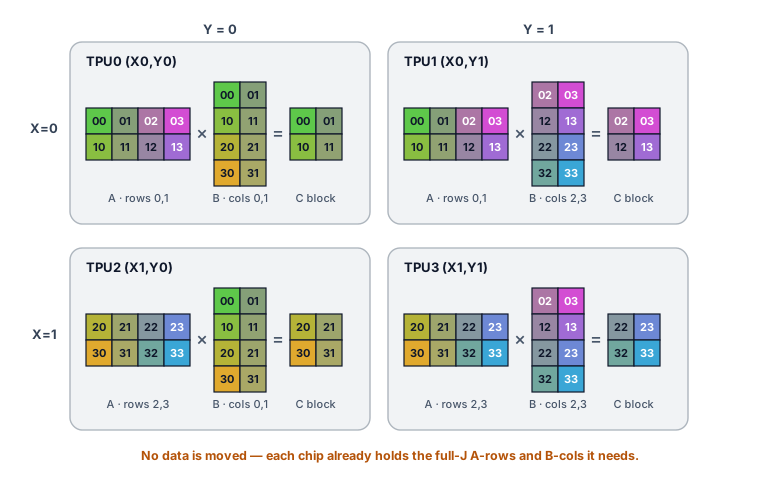
If you want the output replicated C[I, K], that is a separate post-step: AllGather_X then AllGather_Y to strip both subscripts. The matmul itself still needs no communication.
Latency: 0 communication — no collective is needed (the matmul itself still costs compute). Replicating the output, if wanted, costs V/W per gathered axis.
Case 2 — one input sharded on the contracting dim
AllGather the sharded input along J so the contraction is no longer split, then matmul locally.
A[I, J_X] · B[J, K] → C[I, K]
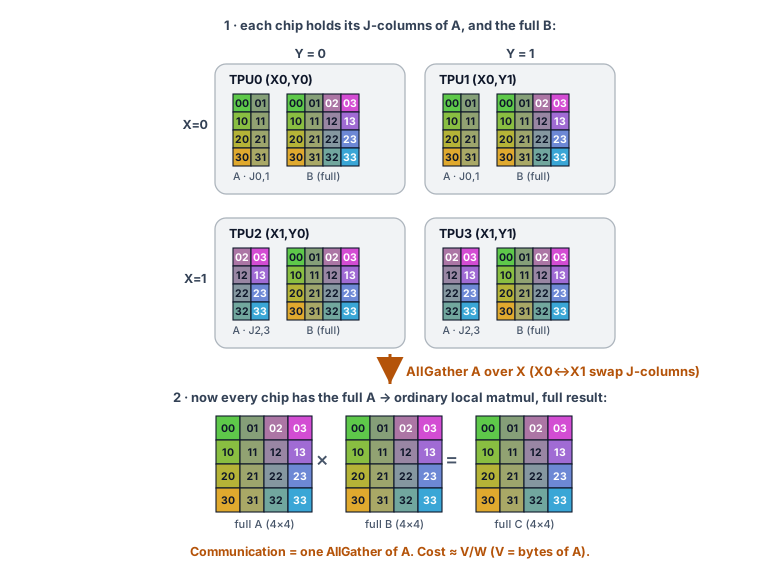
Choice of where to gather: if the output may stay replicated, you can instead multiply shards first → C[I_X, K] then AllGather the result. Both are V/W; gather whichever array (input A or output C) is smaller.
Latency: V / W, where V = bytes of the gathered array.
Case 3 — both inputs sharded on the contracting dim
Each device can multiply its local shards, but because the contracting dim is split, each device only gets a partial sum of the result — it has added up its slice of J, not all of it. Summing those partial sums across the axis with an AllReduce (or a cheaper ReduceScatter if you can keep the output sharded, AllReduce = ReduceScatter + AllGather ) gives the final answer.
A[I, J_Y] · B[J_Y, K]  →  each device holds a partial sum of C[I, K]
AllReduce over Y       →  C[I, K]   (partial sums added up)
Generalization (your observation): the contracting axis Y is the only thing that creates the partial sums. The non-contracting dims are free to be sharded on other axes, and they pass straight through untouched:
A[I_X, J_Y] · B[J_Y, K] → partial sums of C[I_X, K] →[AllReduce over Y]→ C[I_X, K]
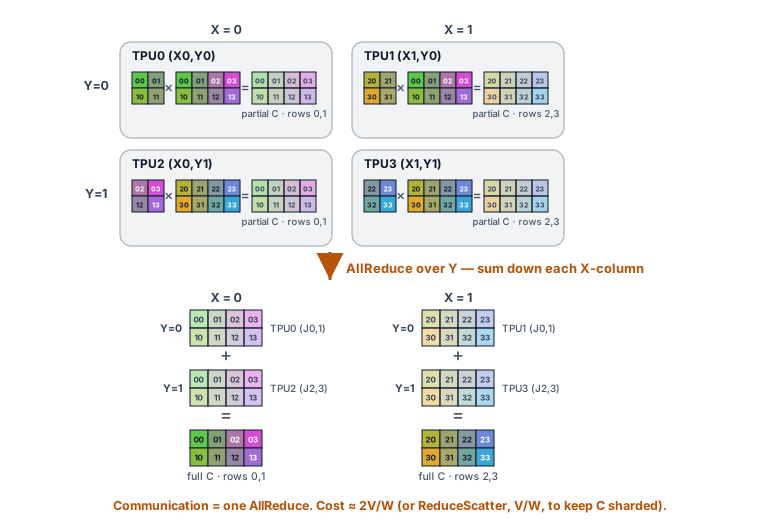
Latency: 2V / W for the AllReduce, or V / W if a ReduceScatter (output stays sharded, e.g. → C[I_X, K_Y]) is acceptable. V = bytes of the result C.
Case 4 — both inputs share a mesh axis on a non-contracting dim
A[I_X, J] · B[J, K_X] ✗ would give C[I_X, K_X]
Why it’s invalid. A mesh axis can shard only one array dimension, so C[I_X, K_X] — both output dims pinned to X — isn’t a legal layout. Concretely, the chip at X = x holds only A’s rows for group x and B’s cols for group x, so it can only ever form the diagonal block C[x, x]. The off-diagonal blocks (C₀₁, C₁₀) are never produced by any chip. (Y here just replicates the same broken computation.)
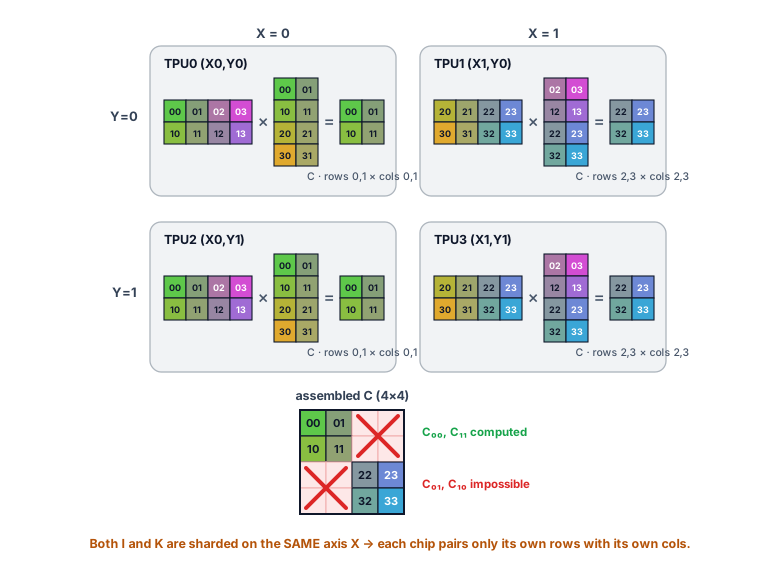
The fix — and why it’s not as costly as it sounds. AllGather one input along X so that input becomes replicated across the X chips — e.g. gather A → A[I, J] — which frees the axis and reduces the problem to Case 1: A[I, J] · B[J, K_X] → C[I, K_X]. This is an ordinary AllGather that spreads a copy across the axis; it does not pull all the shards onto a single device. So the cost is ≈ V/W — the same order as Case 2, not catastrophic.
The real takeaway: avoid this sharding by construction. The wasted gather only exists because two output dimensions were assigned to the same mesh axis. Put I and K on different axes (or leave one replicated) from the start, and the corrective AllGather disappears entirely.
Latency: V / W for the corrective AllGather (V = bytes of the gathered input) — but ideally 0, by choosing a sharding that never needs it.
Summary
| Case | Condition | Operation | Latency |
|---|---|---|---|
| 1 | Neither input sharded on J |
none (output naturally sharded) | 0 (+V/W per axis if you replicate) |
| 2 | One input sharded on J |
AllGather that input | V / W |
| 3 | Both inputs sharded on J (same axis) |
AllReduce result (or ReduceScatter) | 2V / W (or V / W) |
| 4 | Shared mesh axis on a non-contracting dim | AllGather one input | V / W |
Two caveats for every estimate:
- These are bandwidth-bound costs. For tiny arrays (≲ 45 kB/shard on v5e) you hit the latency floor (~1 µs/hop), where cost does scale with axis length:
T = max( T_min · ΣX_i / 2 , V / (W · N_axes) ). - V is always the full global array size (e.g.
2·I·Jforfloat16), not the per-shard size.