
Details and performance roorline analysis plz refer to How to Scale Your Model
One 2-layer MLP (X · W_in → H · W_out → Out) across four sharding schemes. Toy shapes:
X is 2×4 — B = 2 token-rows and d_model = 4 — with d_ff = 8, so W_in is 4×8
and W_out is 8×4.
The MLP is position-wise. Every token flows through W_in/W_out independently —
tokens only ever mix inside attention, never in the MLP. So the batch axis B is just a
stack of independent rows, free to be split across chips (DDP, FSDP) or replicated (TP)
without changing the result.
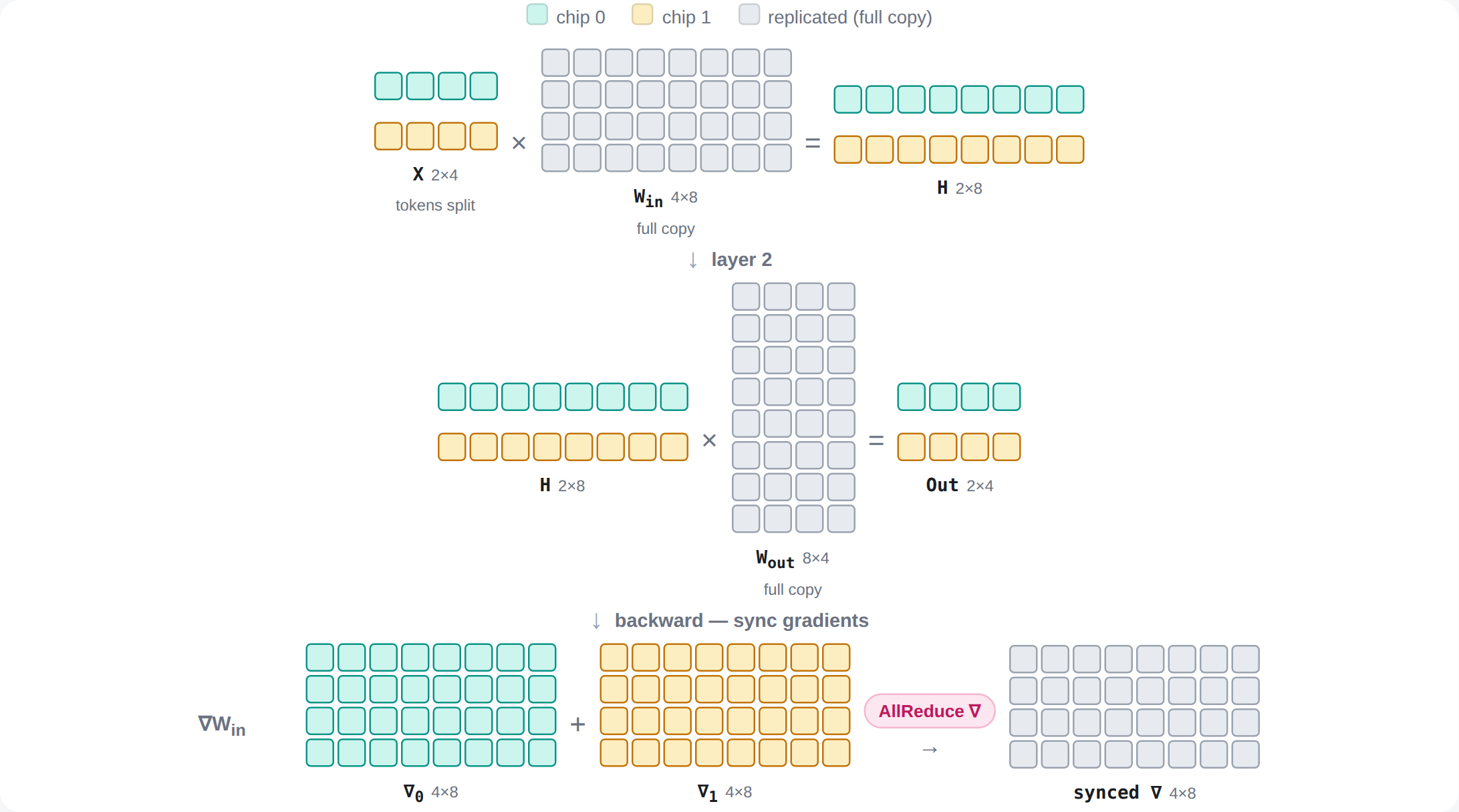
1 · DDP — replicate weights, split batch
Every chip holds the whole model and runs its own token. The forward pass is entirely local (no communication). The only synchronization is a single AllReduce of the gradients in the backward pass. Simple and fast, but memory-heavy: the full model lives on every chip.
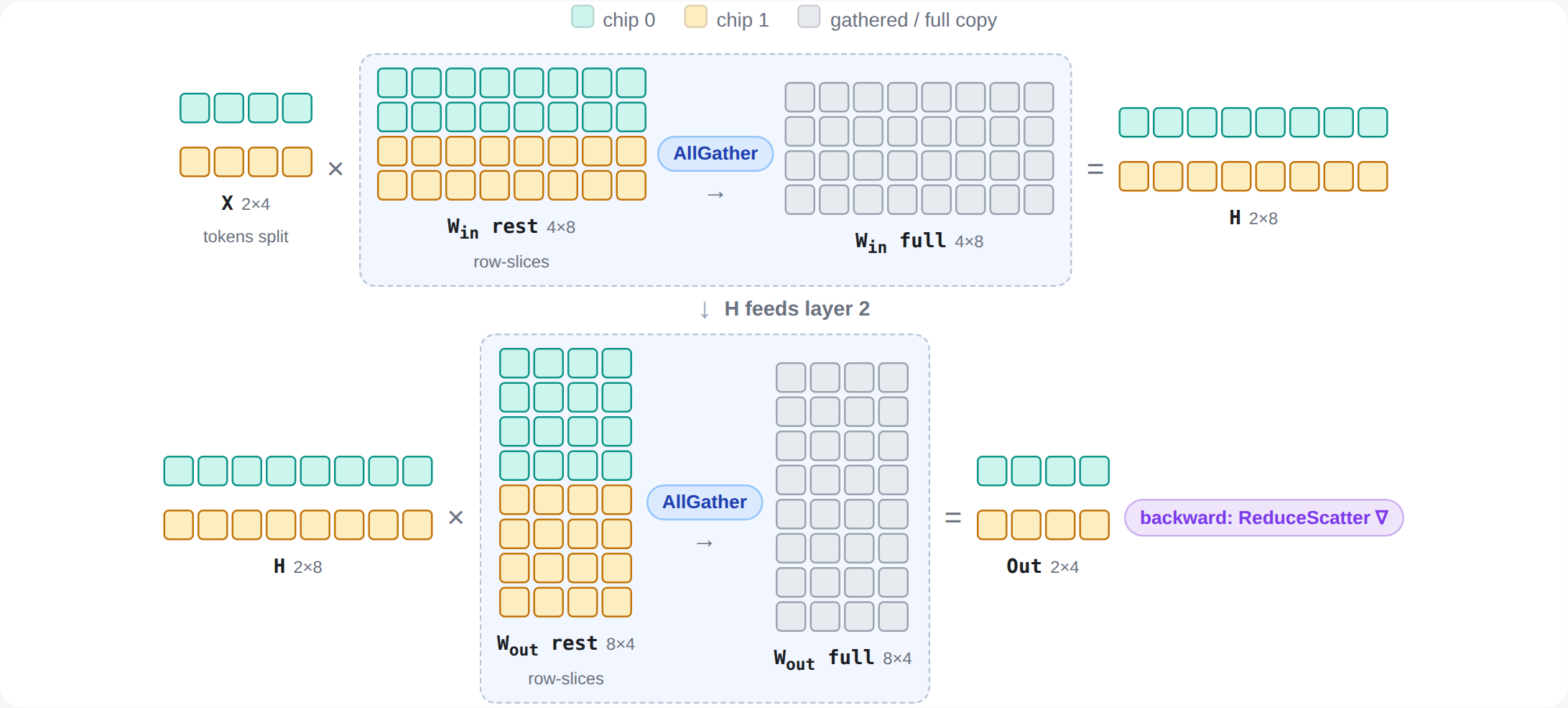
2 · FSDP (ZeRO-3) — split batch and weights
Same data-parallel batch split as DDP, but the weights are sharded into row-slices. Each layer does an AllGather to rebuild the full weight just before the matmul, then frees it; gradients are ReduceScattered back into slices. Peak memory holds only one layer’s weights instead of the whole model.
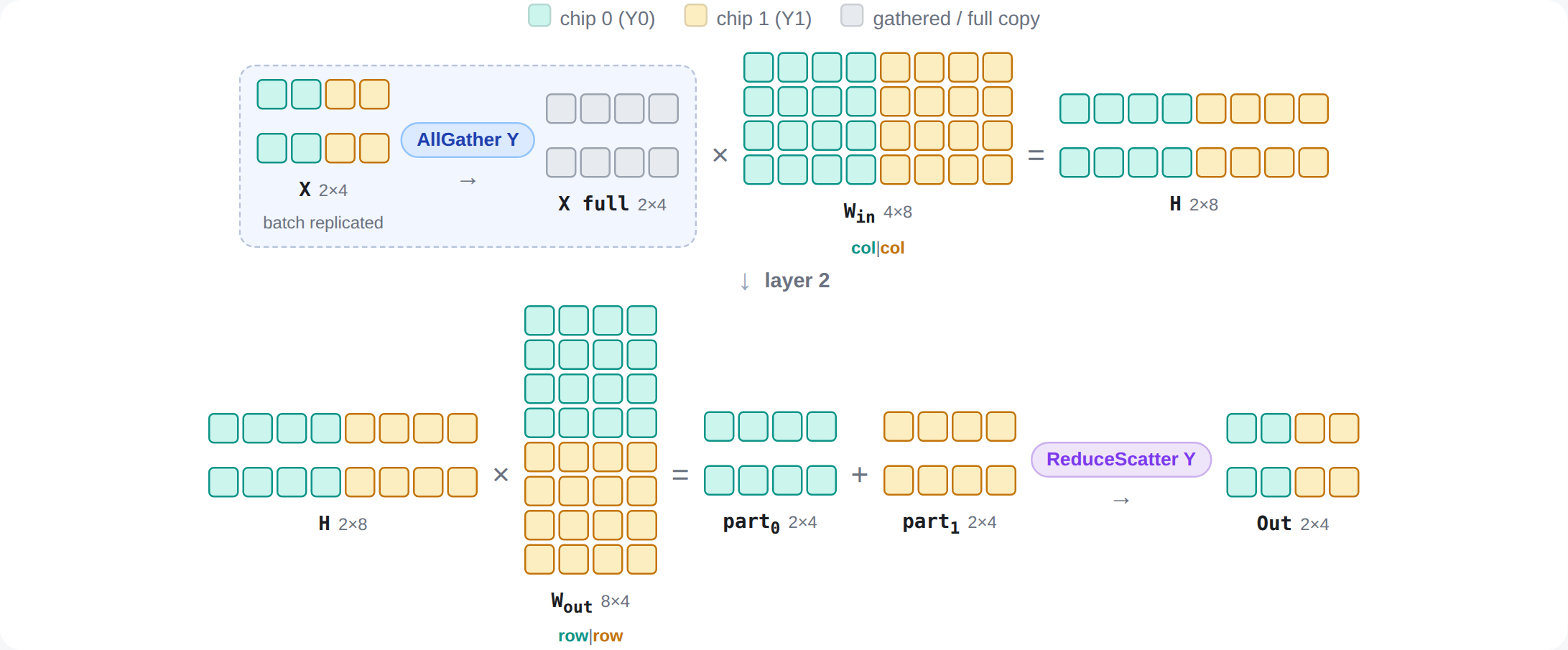
3 · Tensor Parallelism — split weights, replicate batch
The batch is not sharded — it is replicated: every chip holds all B tokens, and they all go through the same weights and the same process (this is why the two input rows in the figure share one coloring instead of being split by chip). What is split is the model: the weights (W_in by columns, W_out by matching rows) and the activations along d_model (In[B, D_Y]). An AllGather rebuilds the full embedding before the matmul, and a ReduceScatter at the end keeps the output sharded (Out[B, D_Y]). This costs no more communication than a plain AllReduce (AllReduce = ReduceScatter + AllGather) but cuts stored activation memory to 1/Y per chip.
4 · Mixed FSDP + TP (2×2 = 4 chips)
Mixed runs FSDP and TP together on a 2×2 mesh (4 chips): axis X = FSDP (data), axis
Y = TP (model). With batch = 2, token 0 lives on the X0 track and token 1 on the X1
track; within a track the two Y-chips split the model. Everything is doubly-sharded: the
input is In[B_X, D_Y] — rows = tokens split on X, columns = d_model split on Y — and
the weights are quadrants, W_in[D_X, F_Y] and W_out[F_Y, D_X].
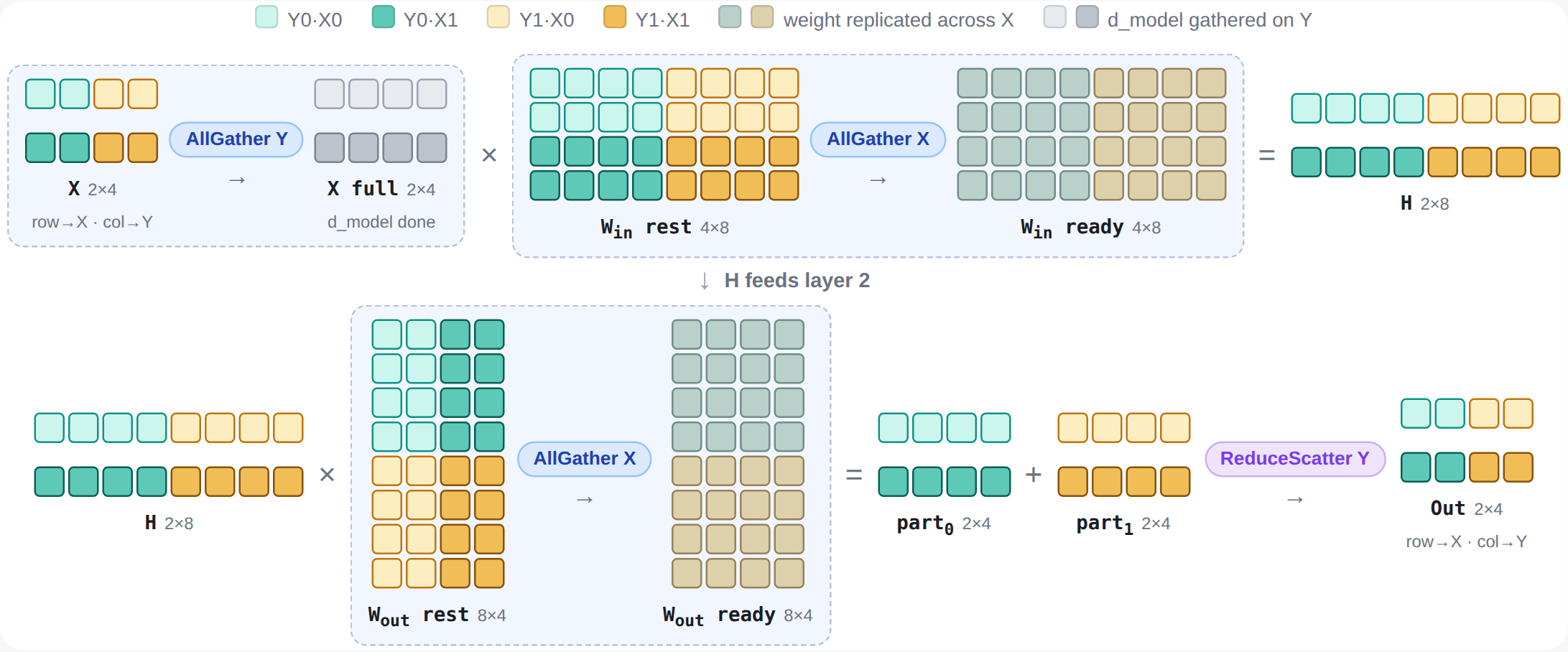
Starting layout — each chip holds its token, half the embedding:
(X0,Y0): token 0,d_model[0:2]·(X0,Y1): token 0,d_model[2:4](X1,Y0): token 1,d_model[0:2]·(X1,Y1): token 1,d_model[2:4]Forward pass — four collectives around two matmuls:
- AllGather Y (activations) — complete each token’s
d_model. Within a track the two Y-chips swap embedding halves, so both hold the full token (X full,1×4, replicated across Y). - AllGather X (
W_in) — rebuild thed_modelrows ofW_in→W_in[d_model, F_Y](replicated across X, still sharded on Y). - matmul 1:
X full · W_in→H[B_X, F_Y](hidden, sharded ond_ffby Y). No comms — the contractedd_modelis fully present. - AllGather X (
W_out) — rebuild thed_modelcolumns ofW_out→W_out[F_Y, d_model]. - matmul 2:
H · W_out→ a partialOut[B_X, d_model](each Y-chip summed only over its half ofd_ff). - ReduceScatter Y (output) — add the two partials and re-shard along
d_model, givingOut[B_X, D_Y]— back to the same doubly-sharded layout the next block expects. So the forward pass is exactly one AllGather-Y (activations), two AllGather-X (the two weights), and one ReduceScatter-Y (output).
Two views running at once. Along X it is data parallel — the X0 and X1 tracks run identical-weight computations on different tokens (steps 2 and 3 reconstruct the same weight on both X-chips), and they sync only in the backward pass, via a ReduceScatter-X on the gradients. Along Y it is tensor parallel — same token, weights split, output reduced. The two axes are orthogonal: X-gathers move weights, Y-gathers/scatters move activations, so they never interfere.
In one line: DDP splits the batch · FSDP also slices weights by row (gather to use) · TP slices weights by column/row and replicates the batch (reduce the output) · Mixed does both at once on a 2-D mesh — AllGather-X for weights, AllReduce-Y for the output.